
What is Pain & Why Do I Feel it?

Nearly everyone experiences pain at some point in their lives. Whether it's a back injury at work or some other musculoskeletal injury, many of the people we see at the clinic experience some type of physical pain. Many times, especially if the pain has been around for a while, these people have seen multiple clinicians or disciplines, sought varying treatments, seen multiple doctors, and continue to experience pain. It limits their ability to do the things they really need or want to do.
Hobbies and activities fall to the wayside as they continue to be limited by their pain. Often, they do not really understand why they are in pain or where their pain is coming from. They just know that it hurts when they try to move or lift or jump. Surprisingly, the question of why someone is in pain is one of the most important questions we can answer in the clinic.
Our goal at Proactive: to empower patients to overcome their pain rather than crippling them by fear or anxiety about it. In this article, I'll share a little bit about the science of pain, what it means for us as people, and how to think about recovering from and overcoming pain.
The Typical Explanation of Pain

How many times has a nurse, doctor, or therapist explained to you what was "going on" in your particular situation or diagnosis? Maybe they used nice anatomy charts or even a 3D model. They explained about tissue injuries, recovery times, and the healing process.
The clinician approached this mini education session from a biomechanical frame of reference. They talked about the tissues, bones, and joints involved and what is or isn't working right and what needs to be fixed, adapted, or changed to improve pain.
The clinician probably feels good about it all. They explained everything well. They provided you with good visuals. Maybe they even took the time to answer your questions.
Does it Work to Think about Pain in this Way?
At some level, thinking about pain from a purely anatomy & physiology view provides some benefit. Especially if you have seen multiple clinicians in the past and still do not have a firm grasp on your diagnosis or dysfunction, this type of explanation gives a baseline understanding of what's going on in your body. However, taking a strictly physical view of pain leaves out a big part of what's going on underneath the surface.
It leaves out the brain, the neuroscience, and the basics about pain itself. Giving a rundown of the tissues and their dysfunction or injuries leaves many people completely unaware of the hidden forces that are likely involved, especially in chronic pain. Focusing too heavily on the physical and anatomical symptoms can also lead to "catastrophizing" thought patterns.
According to John Grohol, PsyD., catastrophization "is an irrational thought a lot of us have in believing that something is far worse than it actually is. Catastrophizing can generally can take two different forms: making a catastrophe out of a current situation, and imagining making a catastrophe out of a future situation." [2]
Mounting evidence shows that approaching focusing too much on the physical, what's referred to as a biomechanical frame of reference, may cause increased fear, anxiety, and stress. It may also negatively affect clinical outcomes of treatments [6].
How many times have you heard something along the lines of "you have bone on bone in this joint"? I cringe when I hear a patient tell me that in the clinic. It shows that they may have a great understanding of the physical or anatomical issues going on. But, it also tells me that they're missing a key piece of information: what pain actually is and what it represents.
Defining Pain From a Biopsychosocial Perspective
As you likely know from reading what I've written about pain, recovery, and the approach we take at the clinic; at ProActive, we think about pain a bit differently.
Here's a short video where I explain pain using recent neuroscience and research:
In recent years, research findings indicate that there is a more effective strategy to think and talk about pain [1] [3] [4] [5] [6]. It involves reframing the way we think and talk about pain. Pain is simply the brain's interpretation of real or perceived tissue threat. That means that pain doesn't always mean that something is damaged or getting damaged in the body. It's your brain's way of protecting you and keeping you in the gene pool.
Knowing this, we can perhaps make more conscious decisions to move, exercise, and push ourselves during treatment or exercises [6].
It also means that you need to be selective in who you listen to about your pain. Studies show that healthcare professionals often have the strongest influence on a person's attitudes and beliefs [1]. Clinicians can alter your understanding of symptoms, their sources, and their meanings. Clinicians can also impact the way you feel about a prognosis and potential outcomes [1].
Words Make A Difference
Whether you realize it or not, what clinicians say to you —and how they say it— has a long lasting impact. Words can either empower you to overcome a dysfunction or chronic pain, or they can cripple you into a negative though pattern. It
I know there have been times when I have said to a patient something like, "well you've got bad arthritis in your shoulder, so that's why it always hurts." Looking back, I can see how those words affected that patient and the way they began to view their shoulder pain and their ability to do certain things.
Many patients and clients that come into our clinics have likely heard things like, "slipped disc", "damaged tissue", "rest until it gets better", or even "you're not going to get better". Whether right or wrong, the clinicians that said those things to them have created a lasting impression that can still be affecting that person when they walk into our clinics for the first time. The first thing we should do with these patients is take the time to explain to them the neuroscience behind their pain to hopefully improve their outlook on their diagnosis and prognosis going forward. The goal should be to empower these people to overcome their pain and dysfunction.
Why Do I Hurt?
So how do you go about explaining what pain is to a patient or a client? Luckily, there have recently been a whole host of articles, books, and courses devoted to the subject of pain science and educating people about pain. A good resource for clinicians and patients alike is the book by Adriaan Louw entitled "Why Do I Hurt?"
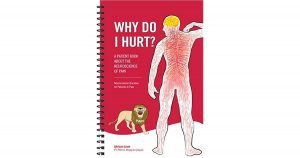
This book is setup to be a patient-focused book on the neuroscience of pain. He has also published a patient workbook to accompany this book. In this book, Adriaan uses simple language and metaphors to explain pain. It starts off by tackling the very tricky concept that pain is a normal part of the human experience, however living in pain is not. He goes on to explain that this is the case for all pain, regardless of location. He explains how modern neuroscience research tells us that we should not focus on the issues within the affected tissues. The book is broken into 3 main sections:
Your Tissues and Your Nerves
Your Noisy Neighbors
Your Body;s Chief Executive Officer
Your Brain's Board Meetings and Airline Maps
Your Body's Injury- Ankle Sprains & Buses
Your Body Under Attack
Your Treatment- Taking Back Your Life
Here's just a brief overview of the book and some key concepts:
Basic Neuroanatomy
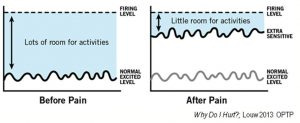
Before & After Injury or Pain
The books starts off by explaining basic neuroanatomy and the nervous system. It explains that your nerves connect everything in your body. They monitor your body and inform you of what's going on in your body and environment. Some of these nerves act as alarm signals for the body and brain. The example of stepping on a nail is used to show how some stimulants cause these nerves to "wake up" and how this pain perception is a necessary part of survival. After some injuries, some of these nerves "wake up" and then take a longer time to calm back down and can even become extra sensitive. There is a great illustration in this first part, pictured to the left, that shows the difference between a normally functioning nerve and a nerve that is "awake" or sensitive. It's a good example of how a persistent alarm or sensitive nerve can affect a patient's function. These alarms can persist for a variety of reasons like the actual pain, tissue injury, or other biopsychosocial issues like family life or stress [7].
How Pain is Interpreted
The book goes on to explain that once this alarm sounds, it can wake up neighbors from down the street, much like a house alarm. This means that nerves next to the alarming ones can wake up, the police (immune cells) are called, and all the other neighbors are checked in on. This means that some older pains or aches can return, but this isn't because there was a new injury, but because the nerves are now sensitive. Adriaan goes on to explain about the brain and how it interprets these pain signals. For example, persistent pain can often be analyzed by the brain very closely. This is similar to the "z" on your keyboard and for or five "z's" showing up instead. He explains that your brain is your body's CEO and once an alarm gets placed on the CEO's desk say from the lower back, the CEO begins to snoop around other areas, the legs, middle back etc. This can be why some of the "noisy neighbors" wake up shortly after an injury or painful experience [7].
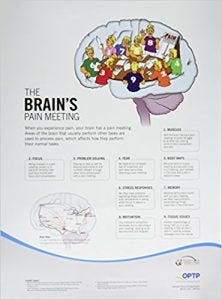
The rest of the books deals with how your brain processes this pain information and how there are different areas of your brain that make a pain map. These areas are:
The sensation area
The movement area
Focus and concentration area
Fear area
Memory area
Motivation area
Stress response area
Each of these areas can be involved in every pain experience. They communicate with each other to "discuss" what the appropriate action or response should be. Each of these responses and areas can be affected differently in each person. How you experience pain from an ankle sprain may be entirely different than I would. Pain is an individualized experience, which can make it difficult to treat [7].
Treatment & Taking Back Your Life from Pain

The final section of the book lays out some tips and strategies for patients to "get their life back". It covers various topics from knowledge, aerobic exercise, medicine, foods, sleep, and even goals and pacing.
This approach to educating patients and clients on some practical steps to help move the needle towards recovery has been shown to decrease hospital stays, improve functional outcomes, and even decrease health care costs for those patients [4] [6]. Clinicians should make efforts to learn this information and then develop ways to share it with clients and patients to help them on their road to recovery.
Summary
In the end, we as clinicians should understand that our words have a lasting impact on our patients and clients that can dramatically affect clinical outcomes. Because of our education, training, and role in the healing process, patients look to us for answers. They believe what we have to say. This is a responsibility that we as clinicians should not take lightly. We should make every effort to communicate to patients in a way that not only educates about the anatomy and physiology behind their pain, but also reframe their pain in a way that empowers them to take the steps necessary to overcome it.
The framework that Adriaan uses in "Why Do I Hurt?" of explaining the what and how followed by practical and concrete strategies for implementing a treatment program can be a good foundation for clinicians to begin to implement in their daily practice. Whether you are treating patients with acute injuries, post-surgical recoveries, or chronic pain, educating and empowering patients and clients to overcome their pain will yield greater results in the long run.
For further reading on the topic of pain science and neuroscience education for patients and clients, check out the references and resources below. There have been books written about the subject and there is always something else to learn.
References
[1] Darlow B, Dowell A, Baxter GD, Mathieson F, Perry M, Dean S. The Enduring Impact of What Clinicians Say to People With Low Back Pain. Annals of Family Medicine. 2013;11(6):527-534. doi:10.1370/afm.1518.
[2] Grohol, J. (2018). What is Catastrophizing?. Psych Central. Retrieved on June 6, 2018, from https://psychcentral.com/lib/what-is-catastrophizing/
[3] Jo Nijs, Mira Meeus, Barbara Cagnie, Nathalie A. Roussel, Mieke Dolphens, Jessica Van Oosterwijck, Lieven Danneels; A Modern Neuroscience Approach to Chronic Spinal Pain: Combining Pain Neuroscience Education With Cognition-Targeted Motor Control Training, Physical Therapy, Volume 94, Issue 5, 1 May 2014, Pages 730–738, https://doi.org/10.2522/ptj.20130258
[4] Louw, A; Diener, I; Landers, M; Puentedura, E. Preoperative Pain Neuroscience Education for Lumbar Radiculopathy: A Multicenter Randomized Controlled Trial With 1-Year Follow-up. Spine: August 15th, 2014 - Volume 39 - Issue 18 - p 1449–1457. doi: dx.doi.org/10.1097/BRS.0000000000000444